Rules of piano music scale fingering
In order to give pupils a correct understanding of the principles of fingering, we will supply the following rules, with which they should make themselves thoroughly acquainted. The scales are divided into five classes, as follows:
- Scales of C, G, D, A and E major, which have the same fingering. The second fingers are always used in both hands at the same time. The thumb is placed on 1 and 4 in the right, and on 1 and 5 in the left hand.
- The scale of B, in which the thumb must be placed on I and 4 in both hands. This scale has all the five black keys, consequently the thumbs come on the two white keys.
- The scales of F-sharp and G-flat are the same on the piano, hence they have the same fingering, The thumb is placed on the 4th and 7th with both hands. As all the black keys are used in these scales, the thumbs fall on the white ones.
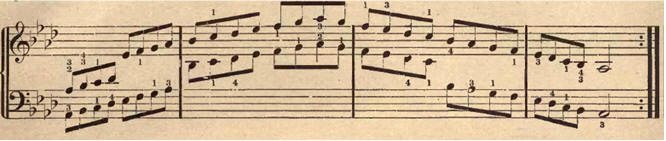
- The scale of D-flat The thumb falls on C and F in both hands.
- The scales of B-flat, E-flat, A-flat and D-flat. In these scales, the thumb is placed on C and F in the right hand and on the III and VII degrees in the left.

General Rule of Fingering. The thumb is very rarely crossed by the second finger, never by the fifth. The third, fourth and fifth fingers never cross each other. As a rule do not use the same finger for two succeeding keys. Do not use the thumb on a black key in scales or runs. In broken or solid chords it may be used thus.
General scale fingering rules for the right hand only
The fourth finger is used but once in an octave of all scales, that of F excepted, in which it is used twice in the first octave. The fourth finger is always used on the seventh of the scale.
In all flat scales, the third finger of the right hand plays B-flat while the thumb plays C and F.
General rules for scale fingering applying to the left hand only
In all scales beginning with a white key, that of B excepted, the third finger invariably comes on the second, the thumb on the fifth and octave. In the scale of B, the third finger begins, but in all other octaves, the thumb plays B. All flat keys, F and G flat excepted, begin with the second finger. The third always falls on the fourth, while the thumb falls on the third and seventh. In G-flat or F-sharp, the third finger begins. The fourth is only used in the white keyed scales excepting in the right hand of the scale of F. and in the left hand of the scale of B and then only for the highest note in the right, and the lowest note in the left hand.
The rule has been laid down that the groups of threes should be played with the 1st, 2d and 3d fingers, while the groups of twos should be played with the 1st and 2d fingers. According to this rule, the scales of E flat and A flat would begin with the second finger, while the scale of B flat would begin with the third. These scales may, however, begin with the third finger in the right hand.
Note to the teacher about piano scale fingering
These rules have been introduced as a guide for your pupil, and an aid to yourself. The more thoroughly these rules are grounded in the pupil’s mind, the less trouble he will have with lingering and the playing of lessons. Usually the scales are introduced in the following order: C, G, D, A, E, B, F-sharp, F, B-flat, E-flat, A-flat, D flat and G-flat. Doubtless, this order has its good sides, especially in so far, that the first five scales all have the same fingering nevertheless, we will adopt a different order, namely, this: C, G, F, D, B-flat, A, E-flat, E, A-flat, B, D-flat, F sharp and G-flat. While the grouping in fingering is somewhat difficult when giving the scales in this order, we nevertheless think it most rational to advance with sharps and flats simultaneously.