Piano Music Syncopation – Excercises
This rhythmical irregularity, if so it may be called, often occurs in music. When a musical sound, Commencing upon light time is held over into heavy time, it is called Syncopation. In the following example this is illustrated:

In a like manner chords may be Syncopated :

With notes of smaller value, Syncopation becomes more difficult, as may be seen from this:

Music syncopation on the piano
The note on the first beat is but an eighth note, consequently before we count two the second note must be struck. To the second half of the second note we count two. This half, together with the first eighth of the third note constitutes the second quarter of the measure. To the second half of the third note, we count three. It and the first half of the fourth note, constitute the-third quarter. To the second half of this note we count four, and adding to it the last eighth of the measure we obtain the fourth quarter. To illustrate this lesson we will write it out in tied notes. Let the pupil first play it as below and then as above.

The teacher must be careful that the pupil has a correct mathematical comprehension of this division of time, for syncopation occurs frequently, and unless it is thoroughly understood, will be a continuous source of trouble both to teacher and pupil.
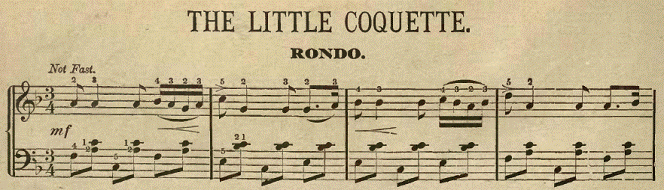
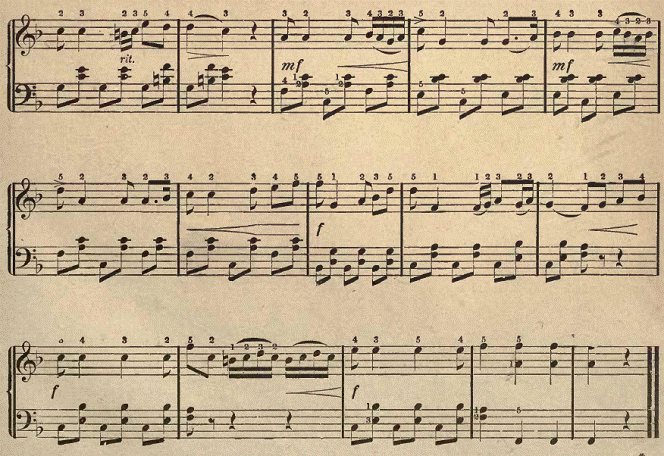
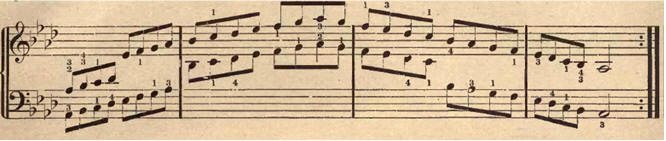
Exercises about syncopation
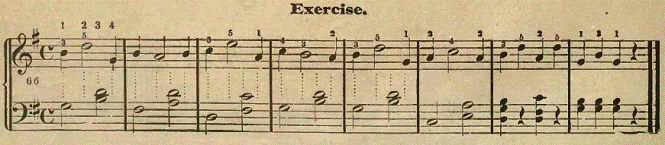
Avoid playing these exercises by ear, or by simply following the rhythmical sense.
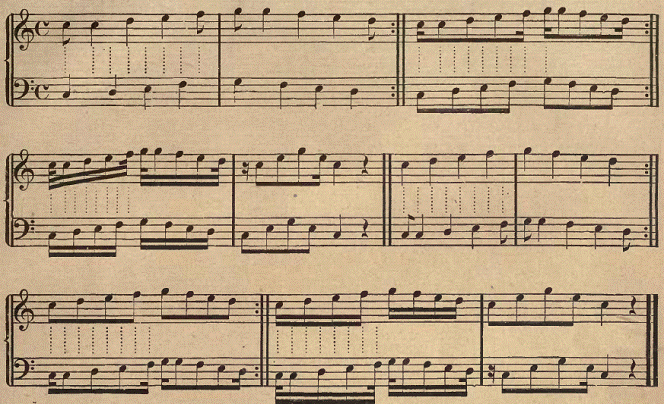
Look carefully at your notes and follow the peculiar division of time. Observe the syncopation. Emphasize the time well. Notice the change in the position of the hand, also the fingering.