Harmonic piano analysis of Beethoven’s For Elise – Sheet Music
Fur Elise is one of the most famous pieces of the piano history. It was composed in 1810 by Ludwig Van Beethoven , a musician who become completely deaf in the last years of his life ; in spite of this oppressive obstacle, he has composed the most beautiful piano and symphonic works.
Every student who starts playing the piano, dreams to be able to execute this masterpiece (Fur Elise) as soon as possible. In this page, I analyze the theme of Fur Elise harmonically and in a stylistic way.
Piano sheet music and analysis of For Elise
The first feature you can note is the simple harmony and melody.
In art simplicity, clearness, naturalness are just like beauty.
Harmony is based on A harmonic minor key. Main chords are two : the tonic one (A minor) and the dominant one that is E7.
Afterwards, you come through variation to C major key (which you can still consider A minor key).
In this part, chords are C major (1st degree in C Maj key) – G7 (5th d. in C Maj) – A min (6th d. in C Maj – 1th degree in A min key) and E7 (5th degree in A min).
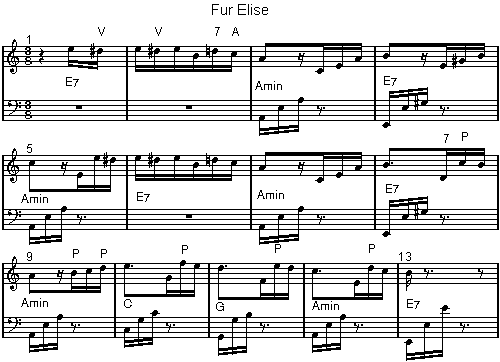
Melodic piano analysis of Fur Elise
Read this table to understand the terminology used in the melodic analysis:
Symbol Harmonic, melodic meaning Chordal note
- P – Passing note
- V – Turning note
- 7 – Seventh of the chord
- A – Anticipated note
As you can see 90% of notes in left hand, melody and accompaniment are simple chordal notes.
Sometimes there is a turning note, that is a note, returning to the chord note, a passage note, that is a note between two chordal ones, an anticipated note, that belongs to the next chord but is played in advance, a seventh interval (in this case simply on dominant chord).
In the central variation, Beethoven introduces a magnificent melodic trick.
To this beginning and simple melodic idea…
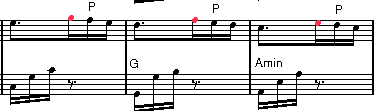
he replaces this last one, dropping an octave the first note of the descending line to create a nicer melodic movement.
The melodic harmony is the same because the next passage note still has the same meaning.
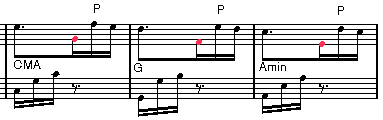
Other characteristic of this fragment is the descending imitation of the beginning part that is a repetition of the beginning idea, dropping a tone.
⇒Download here the Beethoven’s For Elise Piano sheet music.
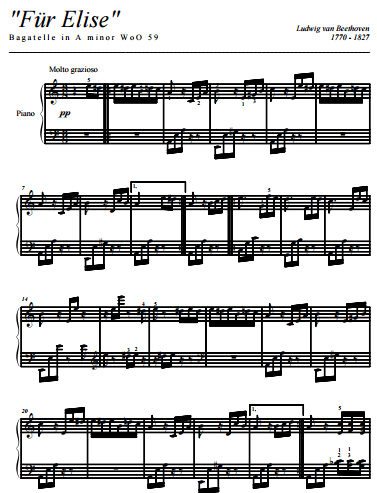
Stylistic piano analysis of For Elise by Beethoven
Other stylistic, harmonic and melodic features you may note are:
- Left hand makes a simple fundamental-fifth or fundamental-third arpeggio
- Following the beginning melodic indecision between note and turning note, Beethoven creates an essential and completely clarifying melody with the next chordal arpeggios. In other words, the German composer stays between indecision and clearness, ambiguity and tonal affirmation (tonic-dominant with arpeggios)
- In the central variation, he puts in evidence F-E-D-C top notes.
- Time 3/8 gives a rhythmic fluency to the piece and a flowing feeling also with the alternation of the hands